

In 2012, Kansas Governor Sam Brownback signed sweeping income tax cuts, calling them a “real live experiment” to see whether lower taxes would stimulate the economy enough to produce more revenue. The plan erased the top income tax bracket and lowered rates across the board, and it exempted income from pass-through businesses like LLCs. Brownback argued the cuts would pay for themselves.
They didn’t.
According to the Kansas experiment entry on Wikipedia, growth generated only enough new revenue to offset 10 to 30 percent of most of the initial tax cut, which forced spending cuts to avoid deficits. Tax revenue consistently came in below expectations, and the state faced a $900 million revenue shortfall. Standard & Poor’s downgraded the state’s credit rating, with downgrades in 2014 and 2016. The state Supreme Court ruled that lawmakers had to increase school funding, and one account says $1.9 billion was diverted from highway improvements between 2012 and 2017 to plug the hole left by falling income tax collections.
In 2017, a Republican-led legislature repealed most of the cuts with bipartisan supermajorities, overriding Brownback’s veto.
North Carolina’s version
North Carolina’s approach is slower and more cautious on paper, but it points the same direction. The flat individual rate is 3.99% in 2026. On July 7, 2026, Governor Stein signed S.B. 257, which progressively lowers the personal income tax rate from 3.99% to 2.99% over seven years: 3.49% for 2027 through 2029, 3.24% for 2030 through 2032, and 2.99% for 2033 and 2034. The law repeals the earlier revenue-trigger cuts for those years and replaces them with an automatic schedule. After the rate reaches 2.99%, it authorizes up to two additional reductions between 2035 and 2040 if revenue thresholds are met.
The corporate side has gone even further.
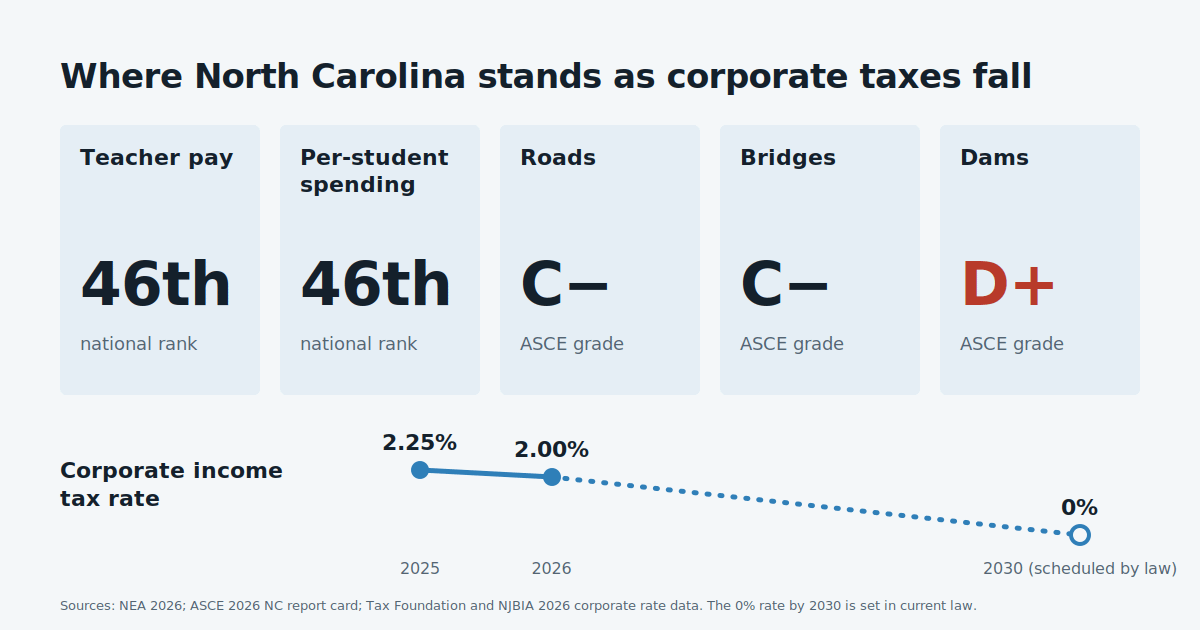
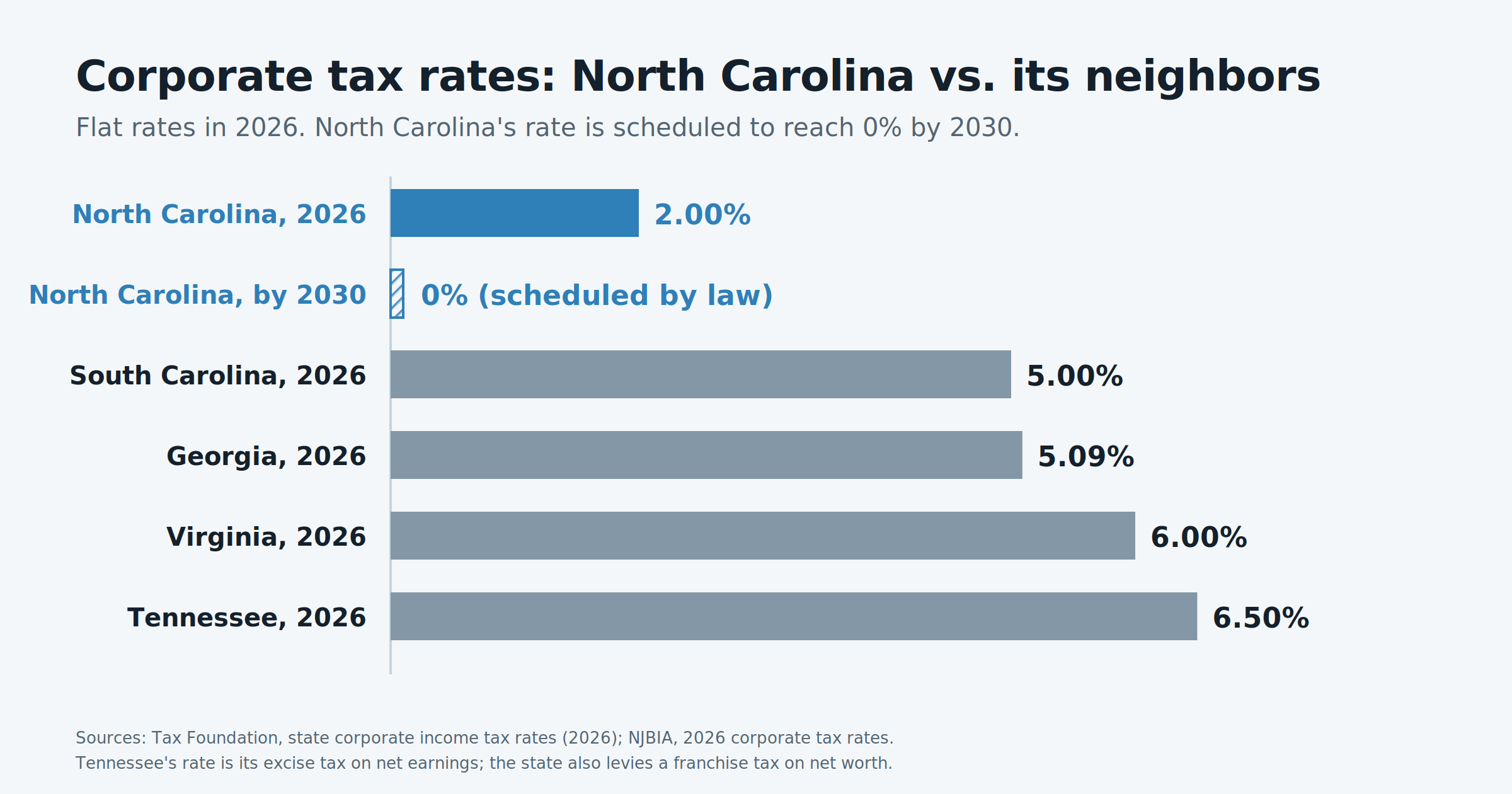
North Carolina has a flat 2 percent corporate income tax rate, one of the lowest in the nation and scheduled to phase down further. By law, the state will phase out the corporate income tax completely by 2030. For comparison, Virginia levies 6% and Georgia is at 5.09%. North Carolina isn’t just competitive with its neighbors on corporate tax. It’s already well below them.
What the state isn’t investing in
The cuts are landing in a state that already invests little in its public schools. The National Education Association ranks North Carolina 46th in the nation for average teacher pay, and it was the only state where teacher pay was projected to drop this year. Per-student spending is about $13,680, well below the national average of nearly $19,000 and lower than every neighboring state except Tennessee. The latest budget includes an average 8% raise for teachers, but starting pay remains below the national average.
Roads, bridges and dams
The physical infrastructure tells a similar story. The American Society of Civil Engineers gave North Carolina’s infrastructure an overall C- in its January 2026 report card, with roads and bridges at C- and dams at D+.
Dams: North Carolina has 7,448 dams, and the report estimates a funding gap of about $5.97 billion to maintain and repair those not rated satisfactory. Nearly half of that, $2.83 billion, is needed for high-hazard dams, the ones where a failure would threaten lives downstream. Hurricane Helene damaged more than 40 dams in the western part of the state, and many communities are still waiting for repairs or replacements.
Bridges: State bridge funding has grown from $150 million in FY2015 to $482 million in FY2025, but more than 4,800 bridges are over 50 years old, and over 6,300 are expected to be by 2035. Bridge funding needs are projected to reach $961 million by FY2027, leaving a $479 million shortfall that keeps widening.
The replacement of the Cape Fear Memorial Bridge is estimated to cost more than $1 billion. And, the State is proposing tolls to pay for the lion’s share of the construction cost.
Roads: Nearly two-thirds of state roads are rated only “fair.” A report to lawmakers found that the statewide road score of 83 remains in the good range, but the most-trafficked roads are deteriorating. The same report said the maintenance budget would need to increase by more than 159% by 2030 to keep roads up. The gas tax, a primary funding source, is declining as more drivers switch to hybrid and electric vehicles.
Much of the recent progress came from Washington, not Raleigh. The federal Infrastructure Investment and Jobs Act has provided $12.3 billion to projects statewide, helping close longstanding gaps. That federal money is a one-time boost, not a permanent funding stream.
The federal squeeze
The tax cuts aren’t happening in a vacuum. The One Big Beautiful Bill Act is shifting costs onto North Carolina just as state revenue is being dialed back.
SNAP: The law makes states pick up 75% of SNAP administrative costs, up from half. North Carolina is one of just ten states where counties administer the program, so the bill lands on county budgets.
The state’s county commissioners estimate $52 million in additional costs this fiscal year and about $69 million annually starting in 2027. Beyond administration, states with SNAP error rates above 6% must begin paying 5% to 15% of benefit costs starting in October 2027. North Carolina had an error rate above 10% in 2024, which would put it in the 15% tier. Small, poor counties have the least room to absorb it. Bladen County faces more than $397,000 in new administrative costs.
Even Towns and Cities that do not administer SNAP will lose revenue as the overall sales tax distribution to the County will be reduced by the State of North Carolina.
Medicaid: The cuts are larger still. One analysis estimates North Carolina will lose about $50 billion in federal funding over 10 years. State officials estimate more than 255,000 North Carolinians could lose coverage under the new work requirement, many because of paperwork rather than unemployment. The law also limits the provider taxes the state uses to fund its share of expansion, which analysts warn could trip the state’s own trigger law and end Medicaid expansion for roughly 670,000 people. NCDHHS says administration alone will cost the state an additional $44.4 million a year.
Why this is the Kansas question again
Kansas didn’t fail because of one bad tax cut. It failed because the revenue went away and the bills didn’t. North Carolina now faces the same arithmetic from several directions at once: automatic state revenue reductions on a fixed schedule, deferred maintenance on aging bridges and dams, and federal changes that push more of the cost of food assistance and health care down to the state and its counties.
When the next lean year arrives, the squeeze will fall on the same places it fell in Kansas: schools, roads, and local services, in a state already near the bottom on education funding.
You can view this post as a web page by clicking on the button.
Sources
Kansas background
The Bond Buyer: Kansas lawmakers end Brownback tax cut “experiment” with veto override
The Bond Buyer: Kansas coverage archive (S&P downgrade, school funding ruling, revenue shortfalls)
Kansas Legislators Repudiate Governor by Overriding Tax Veto
Kansas Reflector via States Newsroom: Ty Masterson shares with Sam Brownback the stigma of Kansas’ failed tax experiment (opinion column)
Angry Bear: Kansas Republicans abandon Brownback; raise taxes over his veto (blog)
NC income tax cuts and revenue forecast
EdNC: NC forecasts budget surplus, but warns tax cuts could impact future revenue
EY Tax News: North Carolina law progressively lowers personal income tax rate over several years
Kiplinger: Your North Carolina Income Tax Cut Is Coming, But There’s a Catch
CPA Practice Advisor: How North Carolina’s Income Tax Rate Compares to Its Neighbor States
Corporate tax comparison
Tax Foundation: 2026 State Corporate Income Tax Rates and Brackets
Tax Foundation: How Do North Carolina Taxes Compare to Other States?
Teacher pay and education spending
Roads, bridges and dams
SNAP cost shift
NC Newsline: NC counties now paying more to help feed hungry people
WLOS: Federal changes to SNAP, Medicaid take effect Oct. 1 in NC
WUNC: New work requirements for Medicaid, SNAP will cost NC millions
Medicaid cuts
NC Newsline: Expenses shifted to the states will cost NC billions
NC Newsline: Medicaid reform will cost NC tens of millions a year
Axios Raleigh: Hundreds of thousands in NC at risk of losing coverage
Figures reflect reporting as of October 2026.