


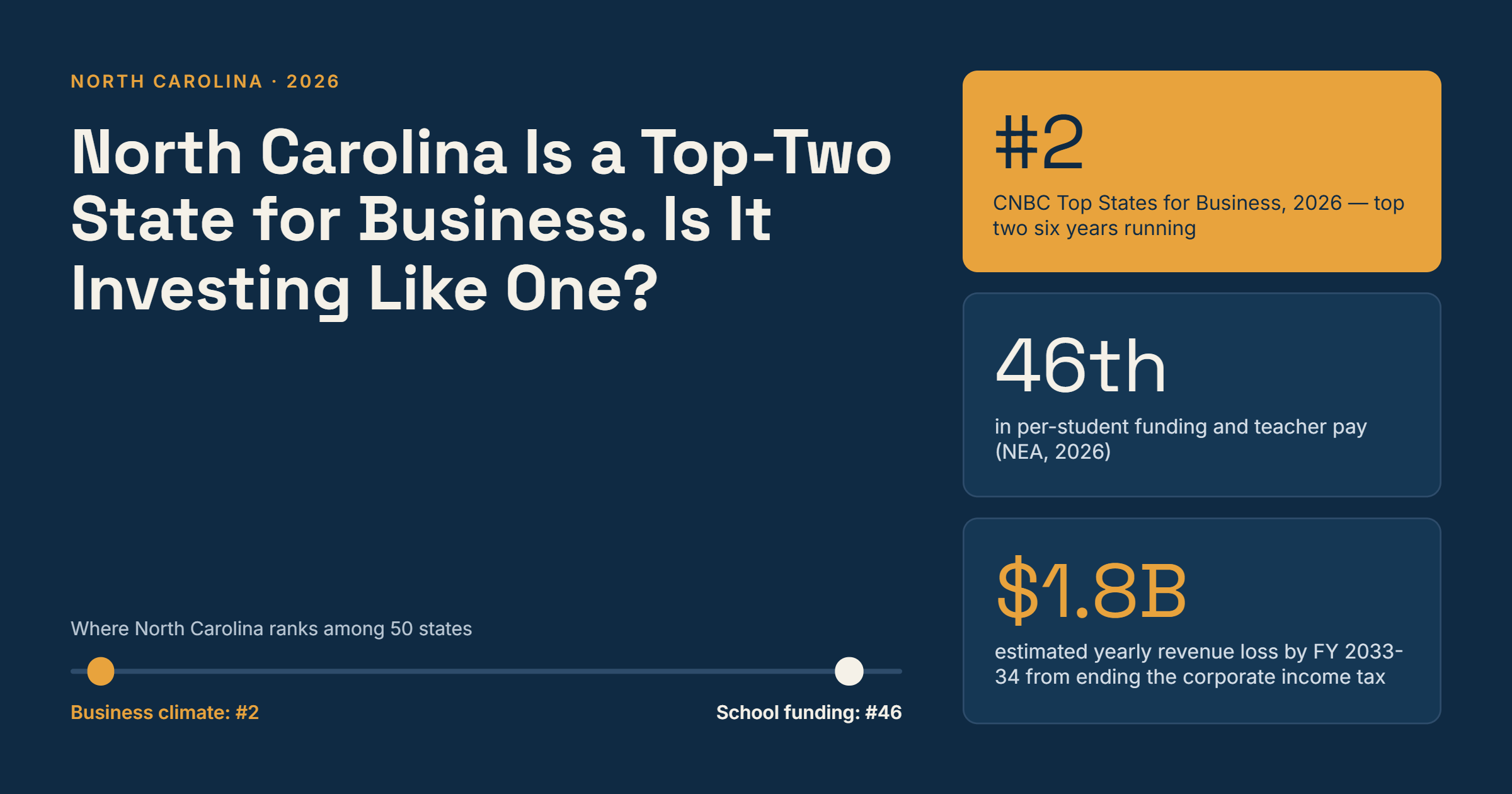
North Carolina has become a business-ranking fixture. CNBC’s 2026 Top States for Business study ranked the state #2 overall after it held #1 last year, which makes six straight years in the top two. The state was also #1 for the economy and #3 for workforce this year. Governors, chambers of commerce, and economic developers have every reason to celebrate.
But a ranking measures what companies see when they arrive. It doesn’t measure what the state is putting into the foundation that attracted them.
The talent pipeline is being underfunded.
Our workforce score depends on public schools, community colleges, and universities. Yet the NEA’s 2026 report has North Carolina 46th in per-student funding, at about $13,680 per student, nearly $5,500 below the national average. The state also ranks 46th in teacher pay. North Carolina was projected to be the only state where teacher salaries fell in 2025-26.
Gov. Josh Stein signed the roughly $34 billion budget in July. Starting teacher pay rises from about $41,000 to $48,000, and the average raise is around 8%. Raises are front-loaded: new teachers get far more than veterans, and teachers with 15 or more years of experience see roughly 5% to 6%. Stein has said the raises move the state’s overall ranking from 47th to 40th, and called the budget a launching pad rather than a landing spot. Teacher groups welcomed the money but argued that it leaves experienced teachers behind and doesn’t fix retention.
The raises don’t end the pay plateau: teachers with 15 to 24 years of service stay on a flat base of $56,820 (up from $53,880) until year 25, when pay rises to $59,000, and master’s pay was not restored and the raises were not retroactive. Board Chair Eric Davis said even the $48,000 starting salary leaves North Carolina below the national average.
Growth puts pressure on everything the state builds and maintains.
Companies don’t just need workers. They need roads that move freight and bridges that stay open, and the data shows the strain.
Bridges
On bridges, the picture is mixed. NCDOT reports that the share of its 13,700 state-maintained bridges in poor condition fell over the past decade from 14% to 8.4%, with a goal of 7% by 2030. But the backlog is still large. The American Road and Transportation Builders Association counts 1,383 structurally deficient bridges in North Carolina, the eighth-most of any state. NCDOT says that replacing all of its poor-condition bridges would cost more than $4 billion. To be fair, engineers stress that a structurally deficient label doesn’t mean a bridge is unsafe. It means the bridge needs more attention and maintenance, possibly including weight limits.
Roads
On roads, the trend is the concern. In NCDOT’s own maintenance report, the share of interstate routes in poor condition doubled from 4% to 8% between 2017 and 2023, while the share of primary routes in poor condition tripled from 5% to 15%. The report’s bottom line was that the state’s roads are in decent condition, but keeping them that way will require a large boost in funding for the coming fiscal year and more modest increases each year after.
Growth makes this harder. Even this year’s business ranking came with warning signs, as rapid growth strains affordability. Population and payrolls can jump in a few years, while infrastructure takes years to plan, fund, and build. Deferred maintenance gets more expensive every year it waits.
Now add a scheduled Corporate income tax cut.
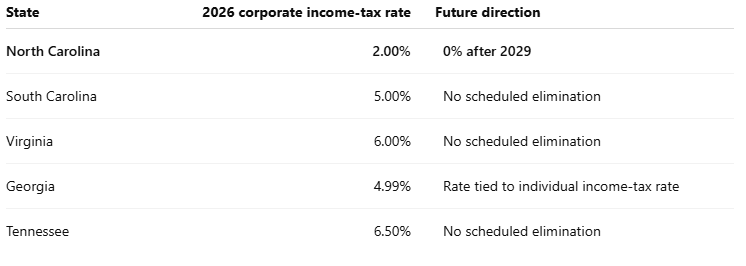
Under current law, the corporate income tax goes to zero in 2030. It’s already the lowest flat rate of any state that levies one, at 2% in 2026. Under the legislature’s plan, the phase-out costs an estimated $1.8 billion in lost revenue by FY 2033-34, according to the state budget office. That comes on top of individual income tax cuts that add up to about $6.5 billion more. Under current law, the combined loss grows to $9.7 billion a year by the same year.
Supporters make a real argument: low taxes are a major reason companies choose North Carolina, and a zero rate would be a powerful marketing tool against competitors like Ohio, Virginia, and Texas. Critics counter that the state doesn’t need to go that far. Governor Stein has argued that because the rate is already one of the lowest in the nation, “you do not need to go to 0.” They also note that more than 70% of corporate income tax collections come from out-of-state companies, according to a Democratic lawmaker.
The question isn’t whether we’re competitive. It’s what we’re competing to become.
The same CNBC study that praised our economy reminds us that the margin at the top is thin: North Carolina missed a repeat #1 finish by just nine points. A state can win on cost for a while.
It stays on top by pairing that cost advantage with schools that produce talent, infrastructure that works, and a budget that can absorb the next downturn.
North Carolina doesn’t have to choose between being business-friendly and investing in its future.
But cutting revenue by billions while schools and infrastructure already lag is a choice to borrow against the thing that made us a top-two state in the first place.
The new members of the General Assembly that take office in January will have lots to consider in these and other critical areas.
A lot to think about ! Thanks for enlightening us!