

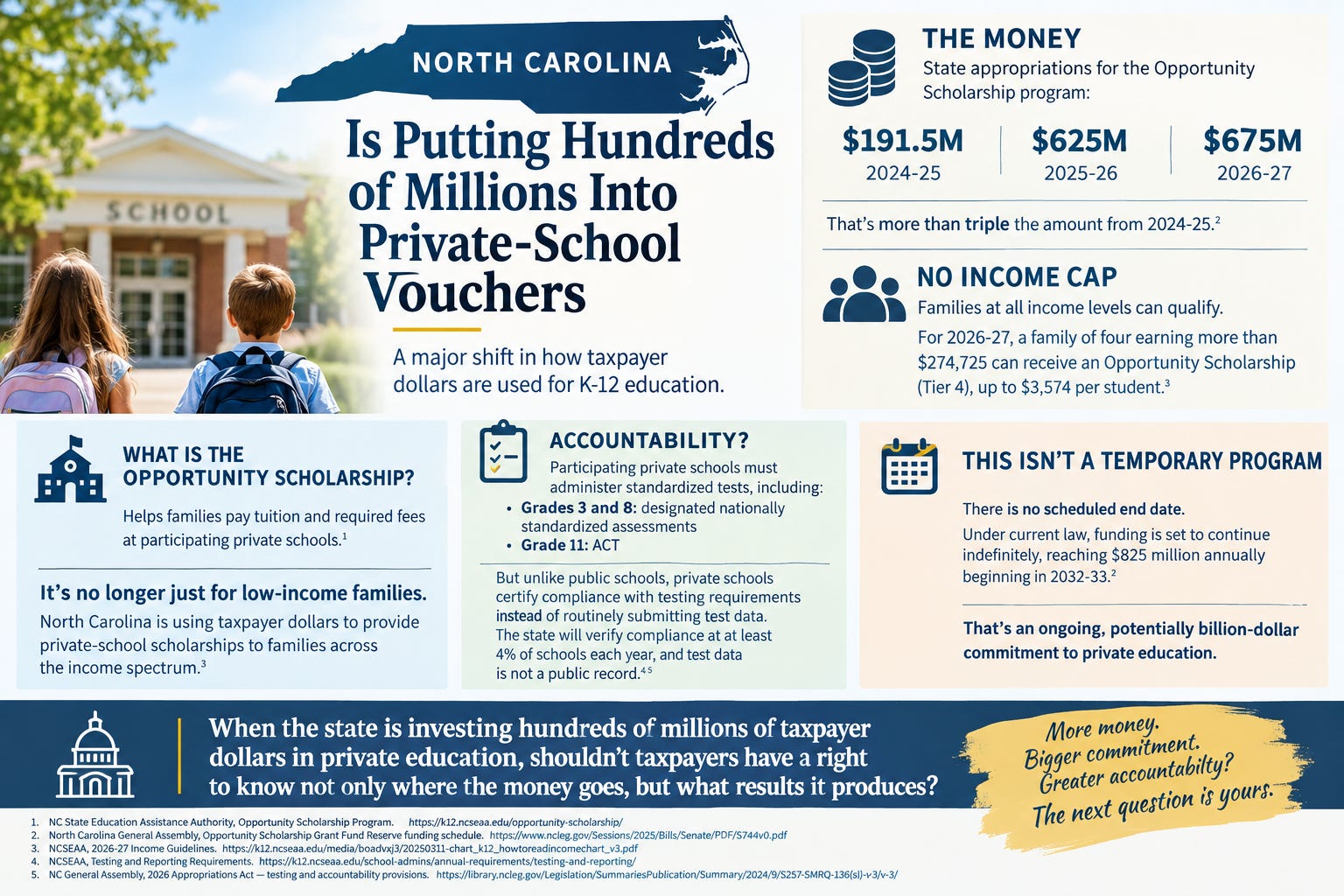
North Carolina is making a major shift in how taxpayer dollars are used for K-12 education.
The state’s Opportunity Scholarship program helps families pay tuition and required fees at participating private schools.¹
The state appropriated $625 million for 2025-26 and $675 million for 2026-27. That is more than three times the $191.54 million appropriated for 2024-25.²
North Carolina's Opportunity Scholarship program — the state's private-school voucher program — is set to cost roughly $6.24 billion in total state funding between fiscal years 2023-24 and 2032-33, under the funding schedule written into state law (G.S. 115C-562.8).
The program started at about $176.5 million in 2023-24, then jumped sharply to $625 million in 2025-26 after the state removed income caps and opened it to all families regardless of income. From there it continues to climb each year — reaching $675 million, then $700 million, and so on — until it levels off at $825 million per year starting in 2032-33, a figure that then repeats indefinitely as a permanent, recurring state expense.
In short: the $6 billion isn't a one-time payment, but the sum of ten years of scheduled, steadily increasing annual appropriations, after which the program settles into a roughly $825 million-a-year fixture of the state budget.
And there is an important change in who can receive the money:
There is no income cap.
Income determines the size of the scholarship, but not eligibility for the lowest award tier. For 2026-27, a family of four earning more than $274,725 falls into Tier 4 and can receive an award of up to $3,574 per student.³
That means the program is no longer limited to lower-income families. North Carolina is using taxpayer dollars to provide private-school scholarships to families across the income spectrum.³
What About Accountability?
Participating private schools are required to administer standardized tests to scholarship students. Beginning in 2026-27, testing includes designated nationally standardized assessments in grades 3 and 8 and the ACT in grade 11.⁴
But the accountability system is different from that used for public schools.
Under changes taking effect in 2026-27, participating private schools certify compliance with the testing requirements rather than annually submitting test-performance data to the State Education Assistance Authority. The state is required to select at least 4% of participating private schools each year to verify testing compliance. Test-performance data collected by the state is not considered a public record.⁵
So there is testing, but private schools receiving Opportunity Scholarship money do not operate under the same public accountability and transparency requirements as traditional public schools.
This Isn’t a Temporary Program
The current funding schedule does not contain a sunset date. Under current law, annual appropriations are scheduled to increase to $825 million beginning in 2032-33 and continue thereafter.²
That makes the scale of this policy difficult to ignore.
North Carolina is committing hundreds of millions of taxpayer dollars every year to private-school scholarships, with no income cap and no scheduled expiration.
The question for taxpayers isn’t simply whether parents should have school choice.
It is whether accountability and transparency should grow along with the price tag — particularly when the state is making an ongoing, billions of dollars commitment to private education.
Sources
1. North Carolina State Education Assistance Authority, Opportunity Scholarship.
NCSEAA Opportunity Scholarship Program
2. North Carolina General Assembly, Opportunity Scholarship Grant Fund Reserve funding schedule.
NC General Assembly — Opportunity Scholarship funding legislation
3. North Carolina State Education Assistance Authority, Opportunity Scholarship Income Guidelines, 2026-27.
NCSEAA 2026-27 Income Guidelines
4. North Carolina State Education Assistance Authority, Testing and Reporting Requirements.
NCSEAA Testing and Reporting Requirements
5. North Carolina General Assembly, 2026 Appropriations Act — Opportunity Scholarship testing requirements.
NC General Assembly — Testing and Accountability Provisions