

North Carolina is on a path to eliminate its corporate income tax by 2030.
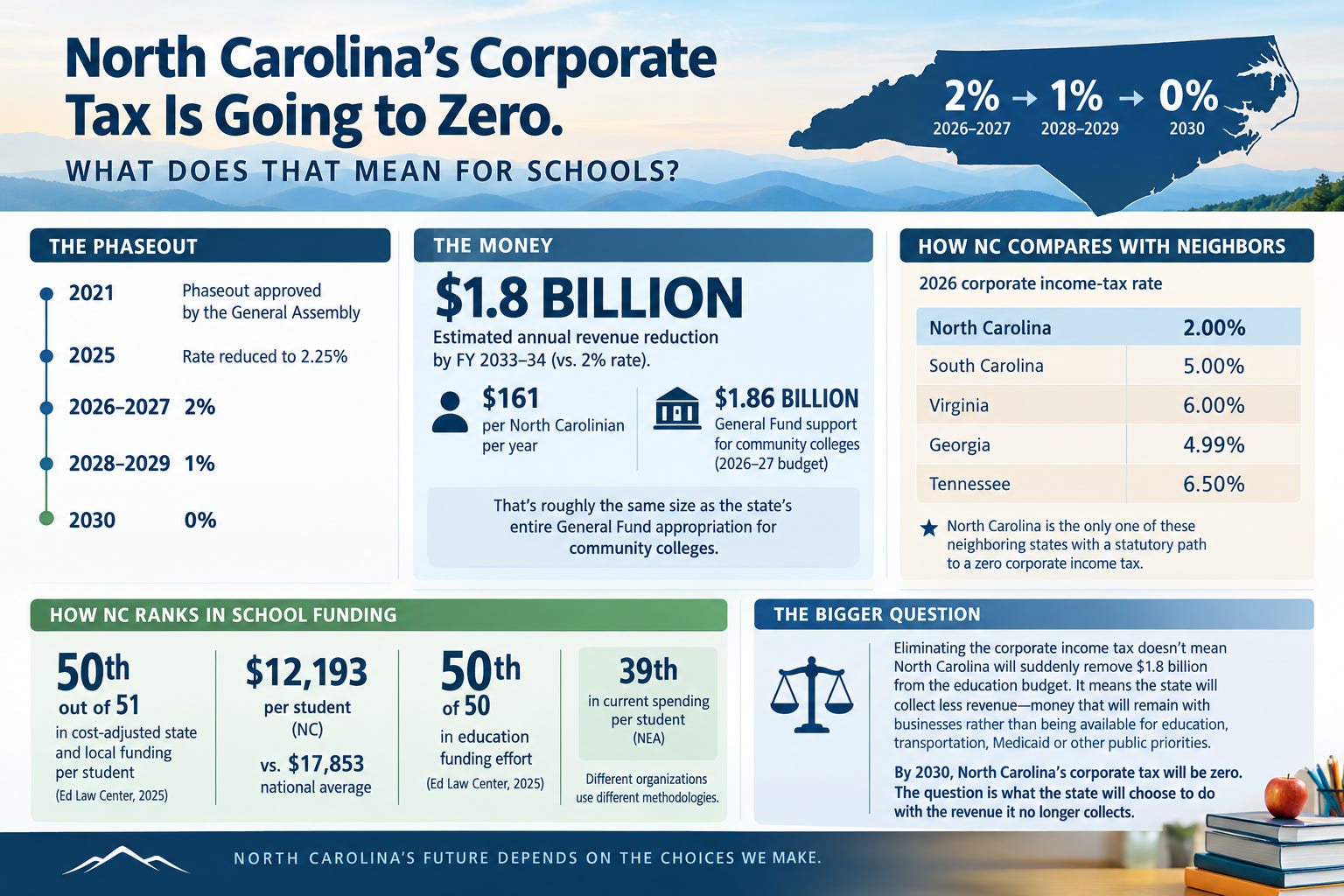
The phaseout was enacted in 2021 as part of Senate Bill 105. The rate is 2% in 2026 and 2027, drops to 1% in 2028 and 2029, and reaches zero in 2030.[1]
That raises a question: How much revenue will the state give up—and how does that compare with North Carolina’s investment in public education?
Billions in foregone revenue
The North Carolina Office of State Budget and Management estimates that eliminating the corporate income tax will reduce state revenue by approximately $1.8 billion annually by FY 2033–34, compared with maintaining the 2% rate.[2]
For perspective, the state’s 2026–27 budget provides approximately $1.86 billion in General Fund support for community colleges.[3]
So the eventual annual corporate-tax reduction could be roughly equivalent to the state’s entire General Fund appropriation for the Community College System.
It also represents about 8.6% of the $15.64 billion in requirements for the Department of Public Instruction.[3]
How does North Carolina compare with its neighbors?
North Carolina is already an outlier among its immediate neighbors when it comes to corporate income taxes.
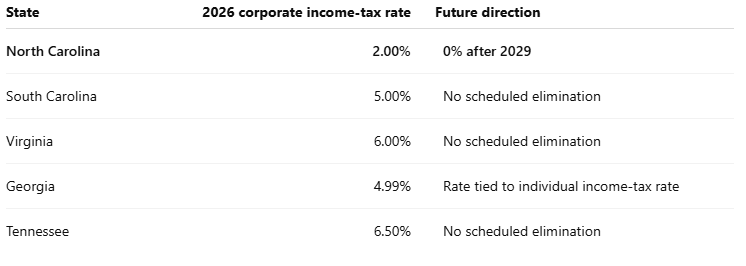
The comparison is based on state corporate income-tax rates; it does not include other business taxes such as franchise, gross-receipts or capital taxes.[4]
North Carolina therefore has a substantially lower corporate income-tax rate today than each of its four neighboring states—and is the only one with a statutory path to a zero corporate income-tax rate.
North Carolina’s 2% rate in 2026 is already less than half of South Carolina’s 5%, one-third of Virginia’s 6%, and about 31% of Tennessee’s 6.5% rate. By 2030, North Carolina’s statutory rate will be zero. (ncdor.gov)
That distinction is important when discussing North Carolina’s tax competitiveness. A lower corporate income-tax rate may affect business decisions, but the ultimate economic effect depends on many factors beyond the tax rate.
How does North Carolina rank in school funding?
The Education Law Center’s Making the Grade 2025 report provides one measure of the state’s education funding.
North Carolina ranked 50th out of 51 states and Washington, D.C., in cost-adjusted state and local funding per student. North Carolina provided $12,193 per student compared with a national average of $17,853.[5]
The same report ranked North Carolina 50th of 50 states in education funding effort—the percentage of the state’s economic resources devoted to K–12 education.[5]
The National Education Association uses a different methodology and ranks North Carolina 39th nationally in current spending per student and 43rd in average teacher salary.[6]
The different rankings illustrate why the methodology matters. But under either measure, North Carolina is not among the nation’s highest-spending states on K–12 education.
The bigger question
Eliminating the corporate income tax doesn’t mean North Carolina will suddenly remove $1.8 billion from the education budget.
It means the state is projected to collect approximately $1.8 billion less each year than it otherwise would have collected under the 2% corporate tax rate.
That money will remain with businesses rather than being available to the state for education, transportation, public safety, health care or other public purposes.
Supporters argue that lower business taxes can encourage investment and economic growth. Critics point to the loss of a recurring source of state revenue.
The policy choice is straightforward: North Carolina is choosing to eliminate a tax that generates revenue for state government.
The question for taxpayers is what the state will receive in return—and how policymakers will balance reduced revenue with education and other public priorities.
And, as revenue shrinks (and it will), the burden will be placed on the backs of local governments that provide essential public services.
Sources
[1] North Carolina Department of Revenue, corporate income-tax rates.
North Carolina Department of Revenue
[2] North Carolina Office of State Budget and Management, Scheduled Income Tax Cuts.
NC OSBM analysis
[3] North Carolina 2026–27 State Budget, Session Law 2026-41.
2026–27 North Carolina Budget
[4] Tax Foundation, 2026 State Corporate Income Tax Rates & Brackets. State corporate income-tax rates are subject to differences in tax bases, deductions, credits and other business taxes.
Tax Foundation — 2026 corporate tax rates
[5] Education Law Center, Making the Grade 2025, North Carolina state profile.
Education Law Center — Making the Grade 2025
[6] National Education Association, Educator Pay & Student Spending: How Does Your State Rank?
NEA state education data