

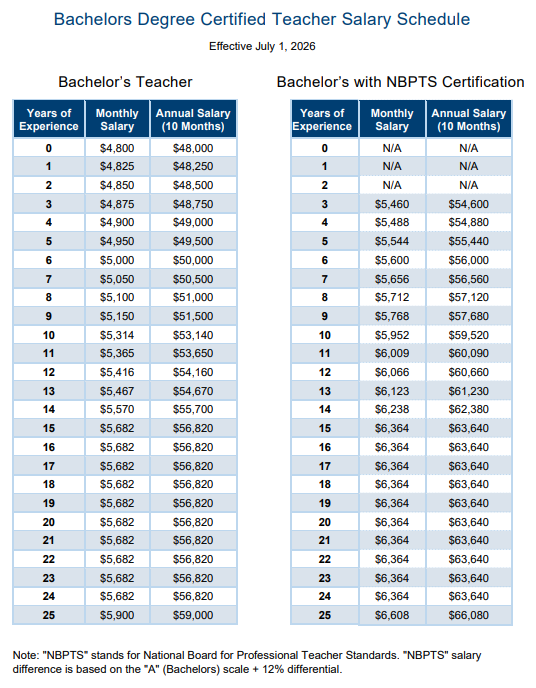
When North Carolina’s General Assembly finally passed a state budget this summer, it ended a two-year stretch without one and delivered the first teacher raises in nearly three years. The state of North Carolina establishes the base salary schedule for certified educators based on their years of experience and education level.
That is real news.
But the story of teacher pay in this state doesn’t end in Raleigh, because for years county commissioners have quietly been doing part of the state’s job: topping off teacher paychecks out of local property taxes.
Where the state stood
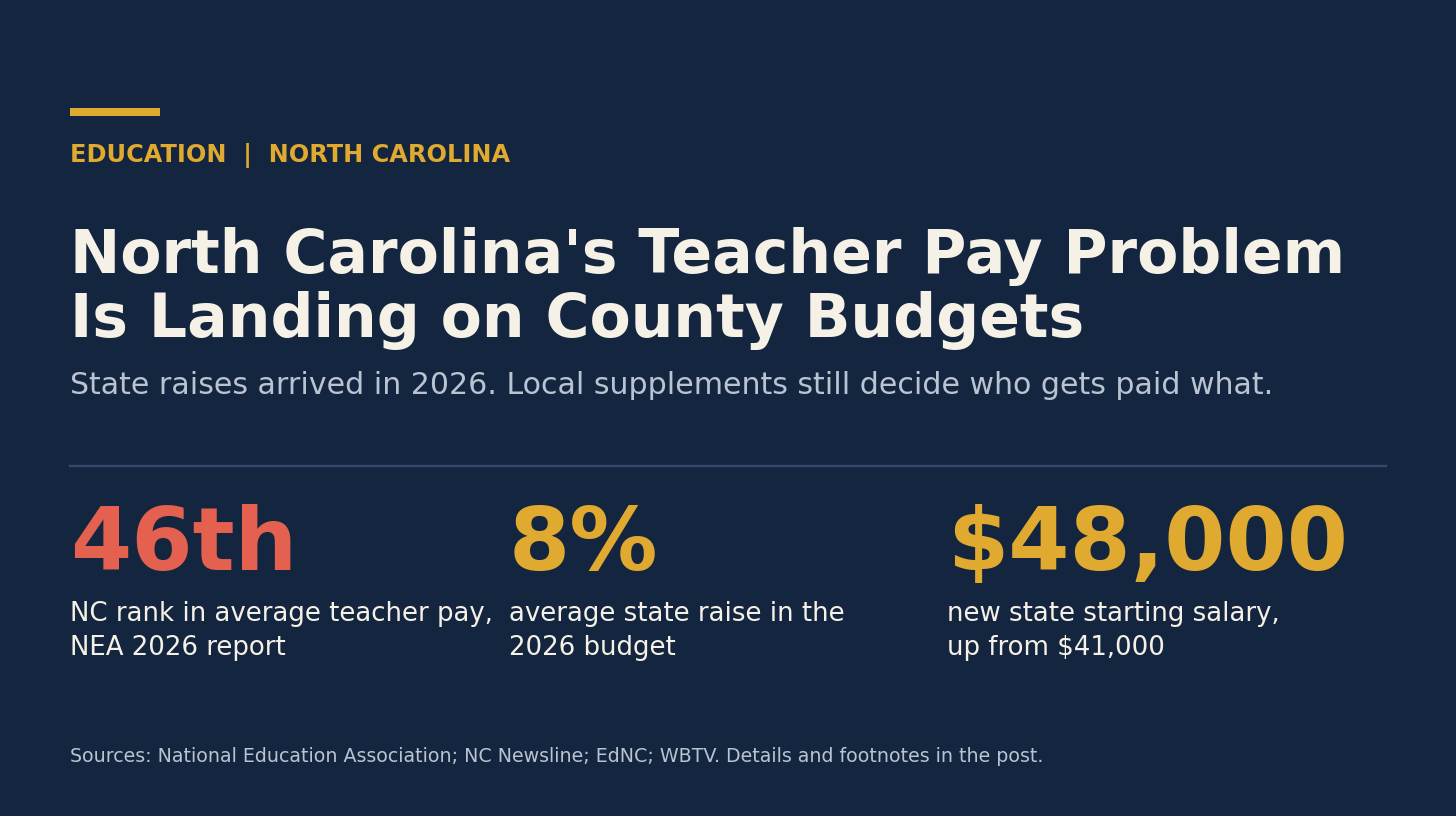
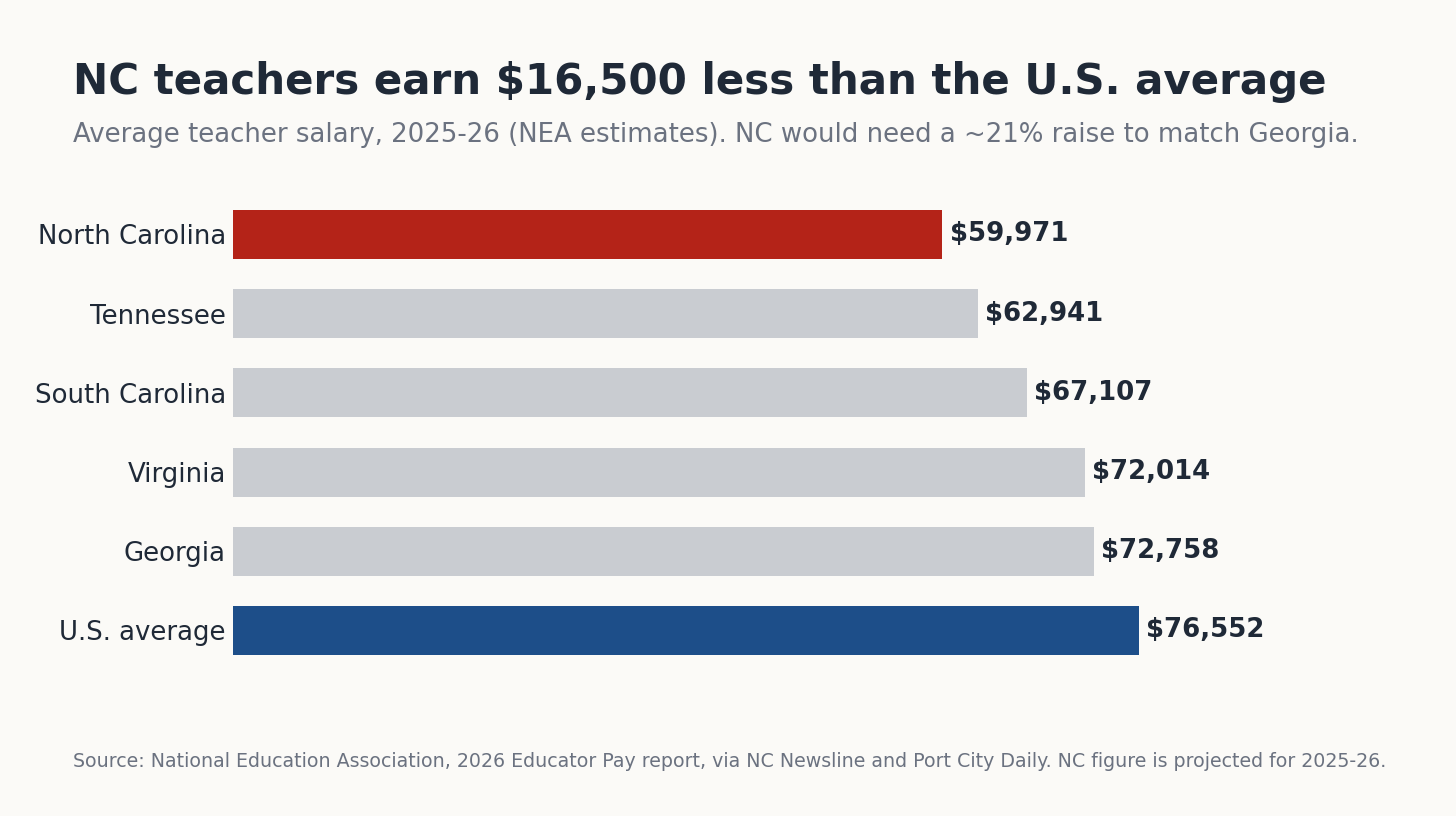
The National Education Association’s 2026 report ranked North Carolina 46th in the nation for average teacher pay, down three spots, and projected it as the only state where average teacher salary would fall this year.[1] The projected average was $59,971 for 2025-26, and North Carolina trailed every neighboring state; teachers would have needed a raise of about 21% just to match Georgia.[2] The state was also spending roughly $13,680 per student, close to $5,500 below the national average.[2]
The immediate cause was a stalemate. Republican leaders in the House and Senate disagreed over tax cuts and the size of raises, and no budget passed for more than a year.[3] Teachers in the meantime were left on an unchanged salary schedule while prices kept climbing. One Forsyth County teacher said she works weekend restaurant shifts to get by.[2]
What the new budget changes
Gov. Josh Stein signed the roughly $34 billion budget in July. Starting teacher pay rises from about $41,000 to $48,000, and the average raise is around 8%.[4][5] Raises are front-loaded: new teachers get far more than veterans, and teachers with 15 or more years of experience see roughly 5% to 6%.[6][7] Stein has said the raises move the state’s overall ranking from 47th to 40th, and called the budget a launching pad rather than a landing spot.[8] Teacher groups welcomed the money but argued that it leaves experienced teachers behind and doesn’t fix retention.[7]
The State Board of Education approved the updated salary schedule in August, and the Department of Public Instruction (DPI) expected districts to implement the increases in August payroll.[14]
The raises don’t end the pay plateau: teachers with 15 to 24 years of service stay on a flat base of $56,820 (up from $53,880) until year 25, when pay rises to $59,000, and master’s pay was not restored.[14] Board Chair Eric Davis said even the $48,000 starting salary leaves North Carolina below the national average.[14]
While the new salary schedule is welcome, the fact of the matter is the State is spending hundreds of millions of dollars on private-school vouchers with no transparency and accountability as to testing results.
And, no income caps with respect to families that participate in the program.
North Carolina Is Putting Hundreds of Millions Into Private-School Vouchers

North Carolina is making a major shift in how taxpayer dollars are used for K-12 education.
The quiet second paycheck: local supplements
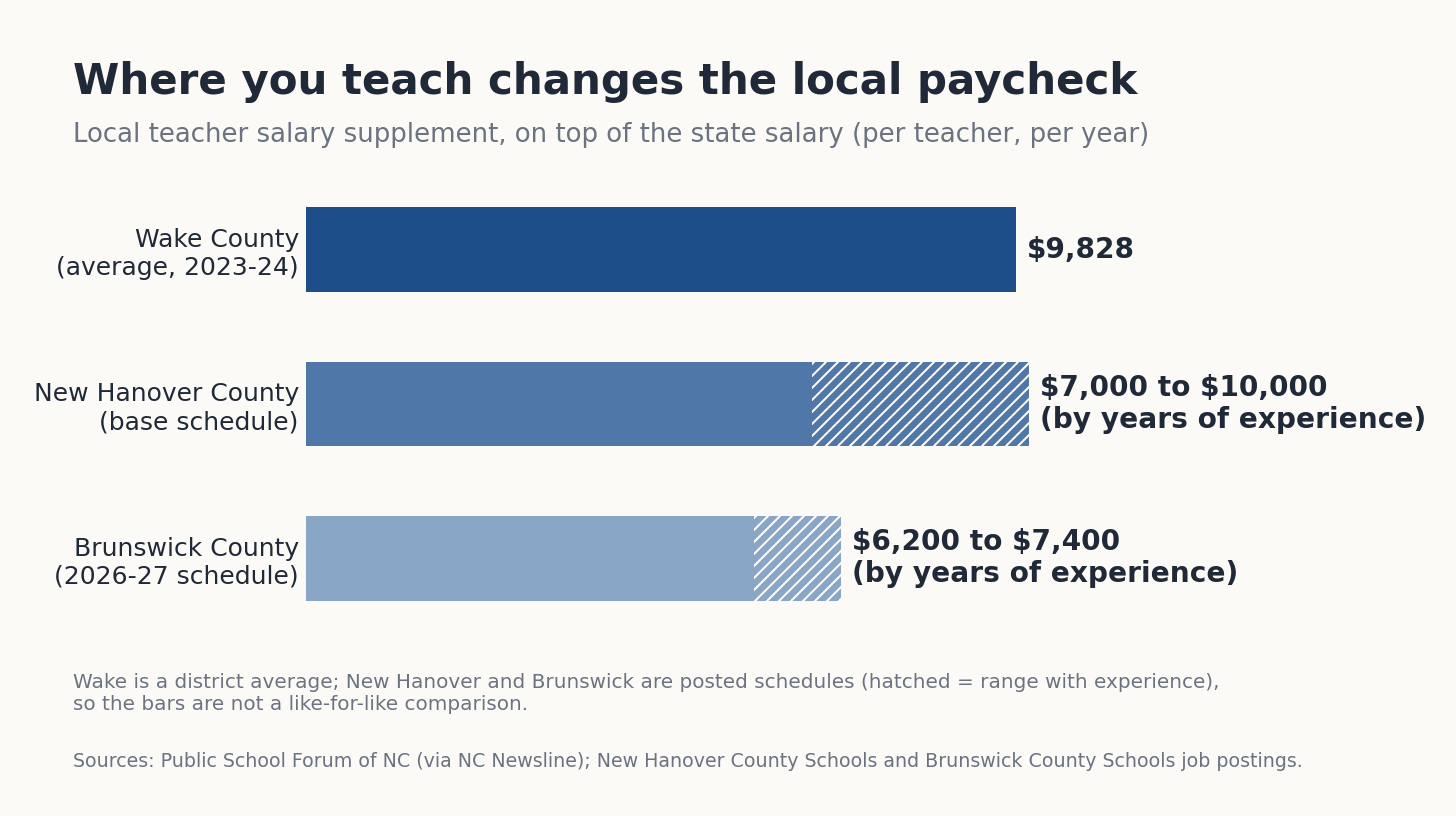
The state sets the base salary schedule. Counties can add to it with a local supplement, and most do. The result is a patchwork. The Public School Forum’s 2026 Local School Finance Study found that teachers in Wake County averaged a local supplement of $9,828 in 2023-24, while in Greene County the average was $1,000.[9] Orange County, the state’s top local spender, provided $456 more per student than the seven lowest-spending counties combined.[9]
The uncomfortable part is who is stretching hardest. The Forum has repeatedly found that the poorest counties tax themselves at higher rates, and put a larger share of local revenue toward schools, than the wealthiest counties.[9][10] A supplement that is a rounding error in a county with a big commercial tax base can be a tax increase in a rural county with a small one. In 2021 lawmakers created a state allotment of up to $4,250 per teacher to help low-wealth and rural districts, an acknowledgment that local capacity can’t carry this alone.[9][10]
Local governments in the middle
Because supplements depend on local budgets, they pull county commissioners and school boards into disputes the state created.
Union County. In 2025 commissioners approved an $8.8 million increase for the school district, expecting it to fund $1,000 teacher raises. The district, citing the missing state budget, delayed the supplement increase, and commissioners complained publicly that they were being blamed.[11][12] The district had asked for more than $14 million to fund $2,000 raises.[11]
Pitt County. For fiscal year 2026-27, the school system asked the county for about $807,000 to raise its teacher supplement by 9%, alongside millions for salary and classified-pay costs.[13]
Burke County. After the state budget passed, the district’s finance officer said he expected local budget needs to grow to cover the anticipated, substantial wage increases.[5]
The Public School Forum of North Carolina’s Local School Finance Study has highlighted variations and trends in local spending for public education across our state’s 100 counties. The purpose of this annual study is to isolate local spending from state and federal spending to examine the capacity and actual effort of counties to support public schools. The Local School Finance Study focuses not only on the amount that counties spend on schools, but also on each county’s investment in relation to their taxable resources. Click on the map for data.

The pattern is that when the state falls behind, locals feel pressure to fill the gap, and when the state raises pay, districts still face rising costs that land partly on county budgets.
The State Board of Education has flagged the same squeeze. Board member Catty Moore said most districts had budgeted only about a 3% raise for locally paid employees, so they are now reworking budgets to find the difference.[14]
Closer to home: Brunswick County
Brunswick County Schools’ 2026-27 job postings list a local supplement of $6,200 for A-licensed teachers with 0 to 3 years of experience, rising to $7,400 at 27 or more years; G-licensed teachers get $200 more at each step.[15] Added to the new $48,000 state starting salary, that is roughly $54,200 for a first-year teacher before benefits (my arithmetic from the posted schedule).
The county government carries much of the load. Under a four-year funding agreement approved in 2025, the county provides 36.5% of its property tax revenue to the schools for operating costs.[16] For FY 2026-27, the county’s recommended school appropriation was $67.4 million, about $4.8 million more than the prior year.[17]
The state raises also come with a local bill.
According to a summary of the district’s July 21 committee meeting, finance staff projected that raises for locally paid staff would cost the district roughly $2 million a year, and the committee voted to implement them.[18] This is not new territory: in early 2020 the school board added $1,000 to its supplement schedule, bringing the local supplement fund to $5.1 million.[19]
What to watch
The state’s raises took effect with this fiscal year, so the rankings in next year’s NEA report will show whether North Carolina actually climbs.
At the county level, the question is whether supplements keep pace or whether commissioners in low-wealth counties again absorb the cost of a state-set pay scale.
If you live in North Carolina, your county’s budget hearings are where the decision gets made, and the Forum’s county profiles will show how yours compares.[10]
Notes
NC Newsline, North Carolina teacher pay projected to decline, ranking 46th nationwide (Apr. 27, 2026).
Same source as note 1; see also North Carolina Association of Educators, North Carolina Falls Again in Educator Pay Rankings, and WFAE, NC falls to 46th in teacher pay in national ranking. NEA’s data is at nea.org/educatorpay.
NC Newsline, Stein touts historic teacher pay raises as NC students return to school (Aug. 20, 2026).
WBTV, North Carolina governor signs $34B budget with teacher pay raises (July 7, 2026).
The Paper (Burke County), State budget passes, teacher raises in the pipeline.
EdNC, General Assembly passes budget with 8% average teacher raises (July 2, 2026).
WBTV, Teachers react to North Carolina lawmakers passing 2026 budget (July 3, 2026).
See note 3.
NC Newsline, Report finds widening gap in local school funding between NC’s richest and poorest counties (Feb. 27, 2026).
Public School Forum of North Carolina, Local School Finance Study; see also EdNC, Public School Forum releases 2026 Local School Finance Study.
Public Radio East / WFAE, Union County Schools pauses teacher salary supplement increases amid state budget uncertainty (Oct. 13, 2025).
Spectrum News, Union County local supplement dispute (Oct. 17, 2025).
WITN, Pitt County commissioners present budget recommendation (May 5, 2026).
EdNC, State Board approves updated educator salary schedules following new budget (Aug. 6, 2026).
Brunswick County Schools, Elementary Teacher job posting with annual supplement schedule, 2026-27.
Brunswick County, FY 2026 Recommended Budget Message (May 19, 2025).
Brunswick Beacon, Brunswick County to hold budget hearing June 1; see also the county’s FY 2027 Recommended Budget Message.
Citizen Portal, Board approves raises effective this month; finance staff project roughly $2 million recurring local cost (July 21, 2026 meeting summary; AI-generated, so check against the district’s records).
Port City Daily, In one year, Brunswick County Schools has more than doubled local supplement budget for staff (Feb. 2020).