


Brunswick County is facing a wastewater bill in the hundreds of millions of dollars, and much of it traces back to a 2023 law, Senate Bill 673.[^1]
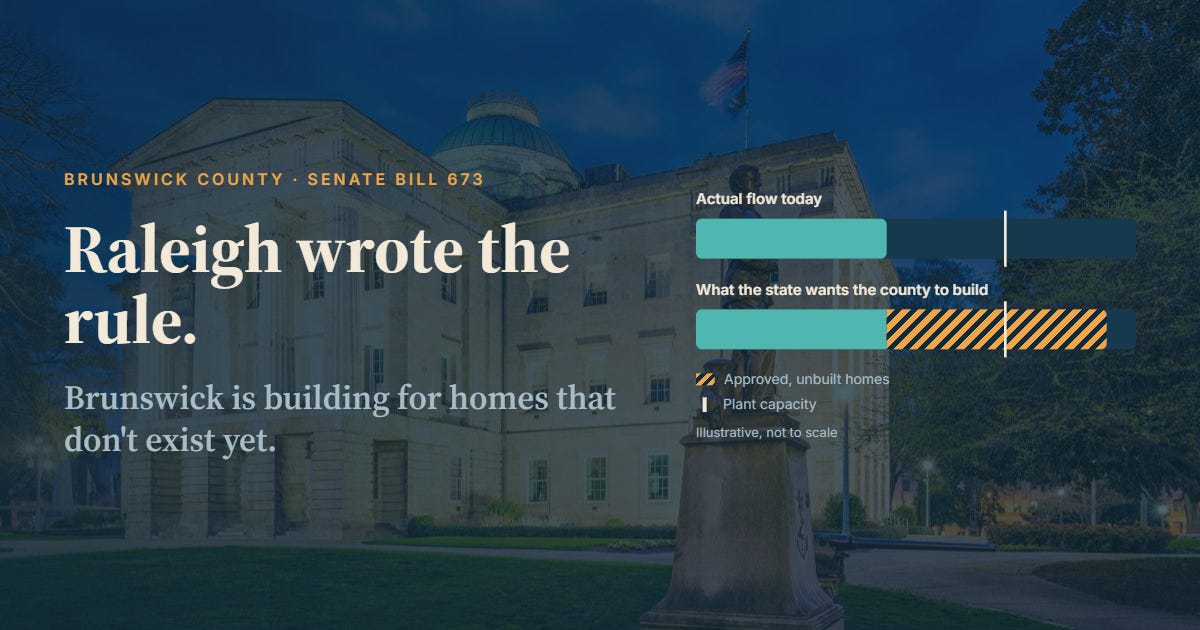
The law makes the state count wastewater from approved but unbuilt homes as if it were already flowing. Under that math, the county’s plants are considered over capacity even though the pipes aren’t full.[^1]
The county has a lot of approved homes.
Brunswick County’s Residential Development Dashboard tracks major residential projects dating back to 2015,[^2] and Port City Daily, citing the county’s GIS tracker, reports roughly 50,000 +/- units in the pipeline, some approved as far back as 2017.[^3] Raleigh is asking Brunswick to build sewer capacity today for homes that may not break ground for years.
What’s the 80/90 rule? North Carolina’s existing rule works off actual flow. When a wastewater plant reaches 80% of its permitted capacity, the operator has to start planning an expansion. At 90%, it must have the construction permits in hand.[^4] The idea is to keep new capacity arriving before the old capacity runs out. SB 673 keeps that framework but adds a second test based on projected flow, so a plant can be over the line on paper while still running well below it in practice.[^5]
The price tag:
The Navassa plant project is about $173 million, split between the county and H2GO, and the Supply and Shallotte expansions could push the total past $700 million.[^6]
Port City Daily reports options ranging from $290 million to $440 million for the three facilities, with the larger one a goal in the county’s 2026-27 capital plan.[^7]
The county has also discussed a $348 million, 6 MGD expansion at the West plant, and a $588 million, 12 MGD option that would cover approved developments without sewer permits yet.[^8]
Who pays? State law has developers cover 75% of expansion costs, and the county and ratepayers typically pay the remaining 25%.[^3] Even a quarter of hundreds of millions is real money for existing customers, and fee debates are already underway.
The bigger question.
Supporters of the law say it forces counties to plan ahead rather than react.
But a formula that counts every approved lot the same, whether it breaks ground next year or sits idle for a decade, makes the county build early and borrow early. The old 80/90 rule already required planning as plants filled. SB 673 moved the trigger from actual flow to promised flow.
County Administrator Steve Stone hits the nail on the head when asked about this matter.
Brunswick County has expansion plans in place for its facilities, but Stone said he’s concerned about the long-term cost of staying compliant with the rule.
“In my mind, that would cause us to spend hundreds of millions of dollars of capital, way before it was needed. Who’s gonna pay for that? Our current customers,” Stone said.
This is not the first time (nor the last) Raleigh has impacted local governments.
As highlighted in a previous blog post, the North Carolina General Assembly is placing the burden of additional costs of SNAP administration (formerly food stamps) on local governments - even those localities that do not administer SNAP benefits.
Support development impact fees? No authority by the General Assembly to allow the County or other local governments to do so.
Support a tree ordinance that prohibits clear cutting? No authority by the General Assembly to allow the County or other local governments to do so.
Support the reduction in density of residential projects? Under a provision placed last minute in a Hurricane Helene relief bill a downzoning can only take place with the permission of the property owner.
North Brunswick Magazine recently published an article regarding the obstacles local governments face from the General Assembly in Raleigh. You can read that article by clicking on the button.
Future Change in the General Assembly
Come January there will be a new legislature with significant changes. Let’s be optimistic for the moment there will be a change in their outlook towards local governments, public education, infrastructure etc. with the New Year.
Sources
[^1]: WECT, “Brunswick County sewer capacity issues halt new construction” (Mar. 2, 2026): https://www.wect.com/2026/03/02/brunswick-county-sewer-capacity-issues-halt-new-construction
[^2]: Brunswick County, “Development Dashboards & Maps” (Residential Development Dashboard; data from 2015 to present, updated monthly, excludes most municipal approvals): https://experience.arcgis.com/experience/6d50938c60044e399c8cf0868f77f385/page/Data-Highlights
[^3]: Port City Daily, “Impact fees spark debate in Brunswick” (Oct. 26, 2026): https://portcitydaily.com/latest-news/2026/10/26/impact-fees-spark-debate-in-brunswick-are-they-allowed-will-they-curb-development-or-drive-up-housing-costs/
[^4]: WilmingtonBiz, “Sewer permit dispute stalls major Brunswick County development” (Mar. 13, 2026): https://www.wilmingtonbiz.com/real_estate_-_residential/2026/03/13/sewer_permit_dispute_stalls_major_brunswick_county_development/27305
[^5]: Brunswick Beacon, “Despite sewer halt, Brunswick County can’t pause development without moratorium”: https://www.newsargus.com/brunswick_beacon/news/despite-sewer-halt-brunswick-county-cant-pause-development-without-moratorium/article_8237b3d8-2b75-5a7a-b374-56256f1f938d.html
[^6]: WECT, “Brunswick County facing hundreds of millions in wastewater expansion costs” (Oct. 27, 2026): https://www.wect.com/2026/10/27/brunswick-county-facing-hundreds-millions-wastewater-expansion-costs/
[^7]: Port City Daily, “Brunswick wastewater expansion to cost hundreds of millions as development outpaces capacity” (Oct. 22, 2026): https://portcitydaily.com/latest-news/2026/10/22/brunswick-wastewater-expansion-to-cost-hundreds-of-millions-as-development-outpaces-capacity/
[^8]: Brunswick Beacon, “Brunswick County faces sewer expansion decision amid rapid growth”: https://www.newsargus.com/brunswick_beacon/news/brunswick-county-faces-sewer-expansion-decision-amid-rapid-growth/article_14610063-d43e-599e-aff3-17afece52b69.html