


The Cape Fear Memorial Bridge has carried traffic between Wilmington and Leland for nearly 60 years, and it’s now on track for a full replacement — one that, for the first time, would come with a price tag every time you cross it.
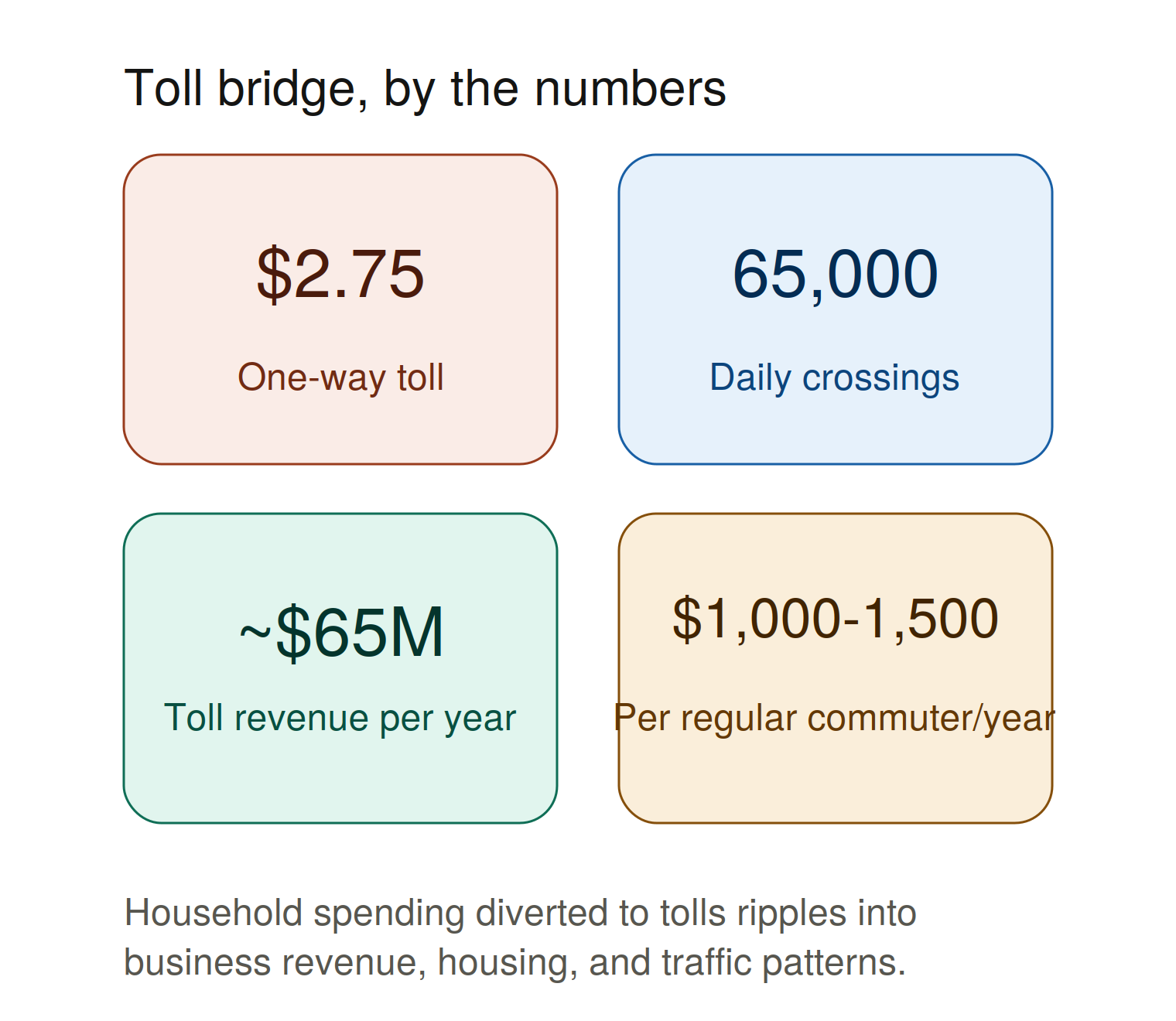
A proposal floated by private developer Delivering Bridges LLC set that price at $2.75 per crossing for passenger vehicles, with higher rates for multi-axle trucks. The North Carolina Department of Transportation rejected the Delivering Bridges proposal.
With an estimated 65,000 daily crossings, that single number ripples out into a much bigger story about who pays, who benefits, and how the region might change shape over the next decade.
NCDOT’s Current Path is to Pursue a Tolled Option
“The tolled option scored really high, scored about maybe 9 or 10 as far as the rank goes. The nontolled option scored way down the list,” Carroll said.
Carroll said NCDOT’s current path is to pursue a tolled option, with toll revenue used to repay costs associated with the bridge.
“The tolls that are going to be used will pay back for the design, the right-of-way acquisition and the construction of the bridge,” Carroll said.
The Direct Hit: About $65 Million a Year
Start with the simple math. At $2.75 one way and 65,000 crossings a day, the toll would pull roughly $178,750 out of drivers’ pockets every day — or about $65 million a year — that would otherwise have stayed in household budgets across Brunswick and New Hanover counties.
For a daily commuter making the round trip five days a week, that adds up to somewhere between $1,000 and $1,500 a year, depending on the final toll structure. That’s not pocket change for the tens of thousands of people who cross the bridge for work, medical care, school runs, or a trip to the beach.
It Doesn’t Stop at the Toll Booth
Money that leaves household budgets for tolls is money that isn’t spent at the restaurant downtown, the hardware store, or the salon in Leland. Regional economists typically apply a multiplier to a direct economic hit like this one to estimate the full “spin-off” effect — the indirect losses to businesses that would have received that spending, and the induced effects as those businesses’ employees have less to spend themselves.
Using typical regional multipliers (roughly 1.5x to 2x for consumer spending in a metro area the size of Wilmington), the total regional economic impact of diverted spending could land somewhere in the $95 million to $130 million range annually — though that’s a back-of-envelope estimate, not a formal published study. It’s also worth noting this isn’t a clean loss to the region: toll revenue funds the bridge itself, supports construction jobs, and — according to UNCW regional economist Mouhcine Guettabi — reduced congestion has real economic value of its own, especially for higher-income commuters for whom time is expensive.
Wilmington and Leland Could Start to Pull Apart
Guettabi’s most striking point isn’t about total dollars — it’s about geography.
Right now, roughly a third of New Hanover County’s workforce, about 52,000 people, commutes in from elsewhere, and a lot of lower-wage workers specifically choose to live in Brunswick County because rent is cheaper there.
A toll changes that calculation. If the added cost of crossing the bridge outweighs the rent savings of living across the river, people will start choosing to live in New Hanover County instead — pushing rents up on the Wilmington side and down in Leland. Guettabi expects this to happen fairly quickly as people “sort into places that make sense,” with slower adaptation following as businesses and developers respond to the shift.
There’s an upside for Leland buried in here: if the town can move fast enough, it could capture more local spending from residents who no longer want to cross the bridge for everyday shopping and dining, building out its own commercial base rather than leaking that spending to Wilmington.
The Workforce Squeeze
The people most exposed to a toll are lower-wage workers who already live in Brunswick County for affordability reasons — cops, nurses, teachers, retail and hospitality workers — many of whom didn’t choose that commute, it chose them, as Wilmington’s housing costs pushed them out.
Guettabi flags this as the central equity concern with any toll: tolling tends to be regressive, hitting lower earners harder as a share of income than higher earners. If employers don’t help absorb that cost, either through wage adjustments or benefits, it could show up in two ways: workers relocating away from the region entirely, or the cost getting passed along in higher prices at local businesses trying to keep staff.
Two mitigation paths get discussed most often:
Targeted toll discounts for lower-income commuters — only possible if the bridge is built as a public-private partnership, since state law limits discounting under other funding models. The State has rejected the private proposal.
Local investment in affordable and multi-family housing inside New Hanover County, addressing the underlying housing cost pressure directly rather than through the toll structure.
Traffic Won’t Just Disappear — It’ll Move
Tolling reliably changes driving behavior. Some portion of drivers will divert to the Isabel Holmes Bridge or the Dan Cameron Bridge (I-140) to avoid the fee, concentrating more traffic on Wilmington’s north side and through downtown streets like 3rd and 5th. Wilmington got a preview of this during the bridge’s 2024 closure, when traffic backed up significantly on those same corridors.
Guettabi doesn’t expect diversion at that scale under a toll — some drivers, especially high earners, will happily pay $2.75 to save time — but he does expect meaningful behavior change: people shifting arrival times, consolidating errands into fewer bridge trips, or choosing to shop and eat closer to home instead of crossing the river. Paradoxically, that could reduce overall congestion even as it reshapes where traffic concentrates.
The Bottom Line
A $2.75 toll is a small number that touches a lot of moving parts: household budgets, local business revenue, housing markets on both sides of the river, workforce retention, and daily traffic patterns. The region’s leaders are weighing that against the alternative — a bridge replacement that has already grown from $245 million to over $1 billion in cost since 2020, with waiting only making the math harder.
Whether the final structure includes discounts, dynamic pricing, or stays flat at $2.75 per crossing will shape a lot of what happens next in Wilmington and Leland — from where people choose to live, to what kind of businesses show up on each side of the bridge.
Sources: WHQR — “What a toll bridge would mean for the Cape Fear region’s economy”, WWAY TV3 — NCDOT public hearings coverage, WilmingtonBiz — private developer toll proposal, Historic Wilmington Foundation — bridge replacement overview